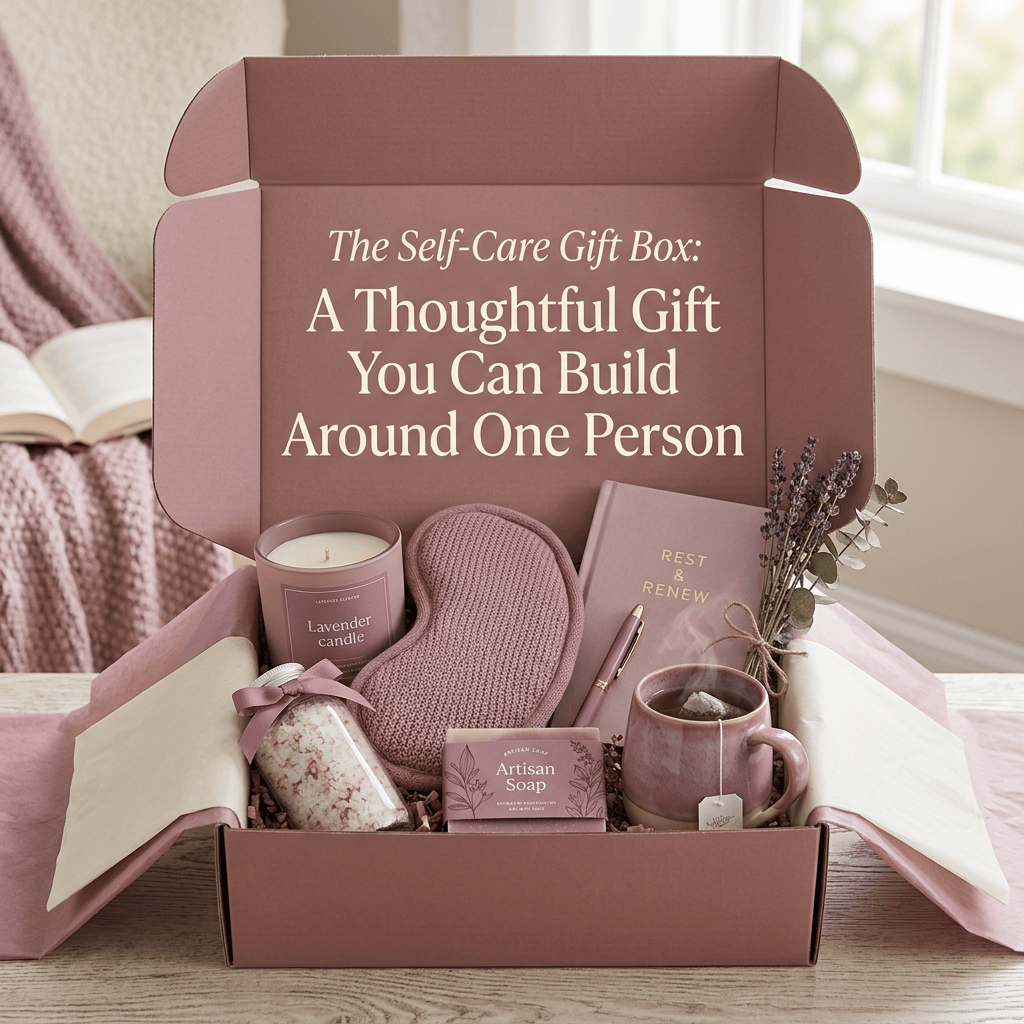
A self-care gift box can be much more meaningful than a collection of pretty products tossed into a basket.
The best ones feel personal.
They make the recipient think, “You actually thought about me when you put this together.”
And that is the real secret to creating a memorable self-care gift: don’t start with the products. Start with the person.
What do they need right now? What helps them relax? What little luxuries would they enjoy but probably wouldn’t buy for themselves? What would make an ordinary evening feel a little more comforting?
Once you know the answers, you can build the entire gift box around them.
Whether you’re creating a box for a stressed friend, your mom, your partner, a college student, a coworker, or someone going through a difficult period, the same principle applies:
Choose a person. Choose a feeling. Build the box around both.
Why a Personalized Self-Care Box Makes Such a Good Gift
Self-care gifts are often associated with familiar items: candles, bath products, fluffy socks, face masks, tea, chocolates, journals, and similar treats.
There’s nothing wrong with those gifts.
The problem is that a generic collection of self-care products can sometimes feel exactly that: generic.
A personalized box changes the experience.
Instead of asking, “What self-care products should I put in a box?”, ask:
“What would make this particular person’s day a little better?”
Maybe your friend has been overwhelmed at work and needs help creating a relaxing evening.
Maybe your mom rarely takes time for herself.
Maybe your partner needs a quiet night at home.
Maybe a college student is surviving on deadlines, caffeine, and very little sleep.
Maybe someone you love is having a genuinely difficult time and could use a small reminder that they’re cared for.
The box doesn’t have to be expensive.
It doesn’t even have to contain many things.
It simply needs to feel chosen rather than assembled.
Step One: Start With the Recipient
Before buying anything, think about the person receiving the gift.
Consider four simple questions:
1. What are they dealing with right now?
Are they stressed, exhausted, busy, lonely, overwhelmed, celebrating, recovering, or simply overdue for some pampering?
Their current situation should influence the entire box.
2. What helps them feel comfortable?
Think beyond traditional self-care.
Do they love reading?
Do they enjoy watching movies?
Are they obsessed with coffee?
Do they love skincare?
Would they rather take a long shower than a bath?
Do they enjoy baking, gaming, gardening, journaling, crafting, or listening to music?
Self-care doesn’t have to look a certain way.
3. What do they already love?
Favorite flavors, scents, colors, hobbies, snacks, books, beverages, or little luxuries can make the box feel much more personal.
4. What might they actually use?
This is particularly important.
A beautiful gift isn’t very thoughtful if half of it ends up unused.
If your recipient doesn’t like scented products, don’t fill the box with scented candles and bath bombs simply because they’re traditional self-care gifts.
If they don’t drink tea, don’t buy six varieties of tea.
Personalization beats tradition.
Step Two: Choose the Feeling You Want the Box to Create
Once you’ve thought about the recipient, choose the main feeling you want the gift to encourage.
Your box might be designed to feel:
- Calm
- Cozy
- Comforting
- Rejuvenating
- Luxurious
- Playful
- Encouraging
- Restful
- Nurturing
- Indulgent
This gives you a theme without forcing you into a rigid product list.
For example, a “calm” box could contain tea, a journal, a soft pair of socks, a relaxing playlist, and a handwritten note.
A “pampering” box might revolve around skincare, a luxurious shower product, a favorite treat, and something soft and comfortable.
A “cozy evening” box could include a book, hot chocolate, snacks, a blanket, and a movie recommendation.
The products are different, but the principle is the same:
Every item contributes to the experience.
Step Three: Build Around One Person, Not a Shopping List
A simple formula can help you put your box together.
Think about including something from several different categories:
Something to use
This could be skincare, a bath product, hand cream, a journal, a mug, or another practical item.
Something to enjoy
Think favorite snacks, chocolate, tea, coffee, a book, music, or another small pleasure.
Something cozy
Perhaps socks, a sleep mask, a small blanket, slippers, or something else that creates physical comfort.
Something personal
This is often the most important part.
Add a handwritten letter, photograph, favorite quote, inside joke, playlist, memory, or another detail that connects the gift specifically to the recipient.
Something unexpected
One small surprise can make the box more fun.
It could be something connected to an inside joke, a tiny hobby-related item, a nostalgic treat, or something you’ve noticed they always admire.
You don’t need all five categories.
Use them as a starting point and adapt them to the person.
How to Build a Self-Care Box for a Stressed Friend
When someone is stressed, the goal isn’t necessarily to give them more things to do.
Instead, create a box that encourages them to slow down.
Start by thinking about what kind of stress they’re experiencing.
If they’re overwhelmed by work, for example, a relaxing evening might be more useful than a productivity-themed gift.
You could build the box around a simple message:
“Tonight, you don’t have to do anything.”
Include things that make relaxing easier: their favorite drink, a comforting snack, something cozy, a relaxing scent if they enjoy scented products, and perhaps a journal for getting thoughts out of their head.
Then add a personal note.
It doesn’t need to be dramatic.
Something as simple as “I know things have been a lot lately. I hope you take a little time for yourself” can make the box feel completely different from a store-bought gift set.
How to Build One for Mom
A self-care box for Mom can be built around something many parents don’t always get enough of:
time for themselves.
Think about what she genuinely enjoys rather than automatically choosing stereotypical “mom” gifts.
Does she love coffee in the morning?
Reading before bed?
Gardening?
Skincare?
Watching her favorite television show?
Baking?
Long showers?
Quiet afternoons?
Build around that ritual.
For example, if she loves peaceful mornings, create a slow morning box with her favorite coffee or tea, a beautiful mug, a small treat, cozy socks, and a handwritten note encouraging her to enjoy an unrushed morning.
The personalization is what makes it special.
Instead of saying, “Here’s some self-care stuff,” you’re saying:
“I know what makes you happy.”
How to Build One for Your Partner
With a partner, think beyond generic relaxation products.
What would make them feel known, appreciated, and cared for?
You could create a box around an experience you can enjoy together or one specifically designed for them to enjoy alone.
For a shared evening, consider favorite snacks, a drink, a movie you’ve both been meaning to watch, cozy items, and a handwritten note.
For a solo pampering box, choose things that encourage them to take some time for themselves.
You can also make the gift more personal by including something connected to your relationship: a favorite photo, a handwritten memory, a playlist of songs that remind you of them, or a note listing a few things you love about them.
That personal element can be worth far more than another expensive product.
How to Build One for a College Student
College students can have very different self-care needs.
Instead of creating a stereotypical spa box, consider their actual routine.
Maybe they’re constantly studying.
Maybe they miss home.
Maybe they’re living in a dorm.
Maybe they’re balancing classes with work.
Maybe they simply need a reminder to take a break.
A college self-care box could combine practical comfort with small treats.
Think favorite snacks, coffee or tea, easy-to-use personal-care items, cozy socks, a notebook, a small entertainment item, and something that reminds them of home.
If you’re sending the box from a distance, a handwritten letter can become one of the most meaningful things inside it.
And don’t underestimate the value of including something they wouldn’t normally buy for themselves but would genuinely enjoy.
A little luxury can go a long way when you’re living on a student budget.
How to Build One for a Coworker
A coworker gift requires slightly more thought because you want it to feel warm without becoming overly personal.
Keep the focus on comfort, appreciation, and everyday enjoyment.
A coffee or tea theme can work beautifully.
So can a small “end of the workday” box with a favorite snack, a nice notebook, hand cream, a small desk-friendly item, and a thoughtful note.
If you know their interests, incorporate them.
If you don’t know them particularly well, keep the items broadly useful and let the message provide the personal touch.
A coworker self-care box can essentially say:
“You work hard, and I appreciate you.”
That can be enough.
How to Build One for Someone Recovering From a Difficult Period
This is where personalization becomes especially important.
When someone is going through a difficult period, avoid making the box feel like a demand to “cheer up.”
Self-care isn’t about pretending everything is fine.
Instead, create something comforting.
Soft textures, favorite foods, a comforting book, a journal, a favorite beverage, a photo, a handwritten letter, or another familiar item can make the box feel reassuring.
You might even make the theme:
“You don’t have to be okay today.”
The most important item may be the note you include.
Let them know they don’t have to respond, entertain you, or immediately feel better.
Sometimes the most supportive gift is simply a tangible reminder:
Someone is thinking about me.
If the person is dealing with a serious situation, tailor the gift to what they actually find comforting and be mindful of anything they may currently be unable or unwilling to use.
How to Build One for Someone Who Deserves a Little Pampering
Not every self-care gift needs a dramatic reason.
Sometimes the recipient simply deserves to be spoiled.
This is your opportunity to lean into the fun side of self-care.
Start with something they consider luxurious.
Maybe it’s an expensive-looking hand cream.
Maybe it’s a beautiful candle.
Maybe it’s gourmet chocolate.
Maybe it’s a silky sleep mask.
Maybe it’s their favorite coffee.
Maybe it’s a book they’ve been wanting to read.
Build outward from that one indulgence.
For example:
Favorite luxury → cozy addition → favorite treat → something fun → personal note
The result doesn’t have to be enormous.
A small collection of carefully selected luxuries can feel much more indulgent than a huge box of random products.
The Secret Ingredient: A Handwritten Note
If there’s one thing I’d encourage you to add to almost every self-care box, it’s a personal note.
Not a generic greeting-card message.
Write something specifically about the recipient.
Tell them why you made the box.
Mention something you appreciate about them.
Recall a memory.
Tell them what you hope they do with the gift.
Even a few sentences can transform the entire package.
For example:
“I put this together because you’ve been doing so much for everyone else lately. I hope you take one evening, ignore your to-do list, and do absolutely nothing productive.”
That instantly makes the gift feel intentional.
The note doesn’t need to be beautifully written.
It needs to be true.
You Don’t Need to Fill the Box
One of the biggest mistakes people make when creating gift boxes is feeling like they need to fill every available inch.
You don’t.
In fact, fewer carefully chosen items can make the gift feel more luxurious.
Instead of buying ten inexpensive things simply to make the box look full, choose four or five things that genuinely suit the recipient.
Think:
One useful thing.
One comforting thing.
One enjoyable thing.
One personal thing.
That’s already a gift.
If you find a fifth item that genuinely belongs, add it.
If you don’t, stop.
The empty space doesn’t matter.
The thought does.
Presentation Matters — But It Doesn’t Have to Be Complicated
You can make a simple box look beautiful without spending a fortune on packaging.
Choose a box, basket, reusable tote, or container that suits the recipient.
Then consider:
- Tissue paper
- Shredded paper
- A handwritten tag
- Ribbon or twine
- A small card
- Their favorite color
- A simple theme
You could even choose a reusable container that becomes part of the gift.
A coffee lover might receive everything inside a large mug.
A book lover might get a reading-themed box.
A college student could receive everything in a useful storage basket.
The container itself can become another thoughtful part of the gift.
Make the Box Tell a Story
Here’s a simple trick that can make your gift feel especially thoughtful:
Arrange the items as an experience rather than a collection.
Imagine the recipient opening the box and discovering:
- A note telling them to take the evening off.
- Their favorite drink.
- Something cozy.
- A favorite treat.
- Something relaxing to do.
- A final surprise.
Now you’ve created a little self-care ritual.
You’re not just giving them products.
You’re giving them permission to pause.
And that is often the real gift.
A Simple Formula You Can Use for Anyone
If you’re still unsure where to begin, use this five-question formula:
Who are they?
Think about their personality, interests, routines, and current situation.
What do they need?
Rest? Comfort? Encouragement? Fun? A distraction? A little luxury?
What do they love?
Favorite flavors, hobbies, scents, books, beverages, colors, shows, or activities.
What would they never buy themselves?
This is where a small luxury can make the box feel special.
What do I want them to feel when they open it?
Loved? Relaxed? Appreciated? Encouraged? Spoiled? Remembered?
Answer those five questions, and your gift practically designs itself.
The Best Self-Care Gift Isn’t Really About Self-Care
That’s the funny thing about personalized self-care boxes.
They may contain candles, snacks, skincare, books, cozy socks, tea, coffee, or other little luxuries.
But those aren’t necessarily what makes the gift meaningful.
The meaningful part is that you paid attention.
You noticed that your friend has been stressed.
You remembered that your mom loves slow mornings.
You know your partner’s favorite treat.
You remembered what your college student misses from home.
You noticed what makes your coworker smile.
You know what comforts someone who has been having a difficult time.
That’s what turns a collection of objects into a thoughtful gift.
So the next time you’re searching for the perfect present, don’t start by asking:
“What should I buy?”
Start with:
“Who am I giving this to?”
Then build the box around them.
Because when a gift feels like it could only have been made for one particular person, that’s when you know you’ve wrapped up something truly special.

Leave a Reply