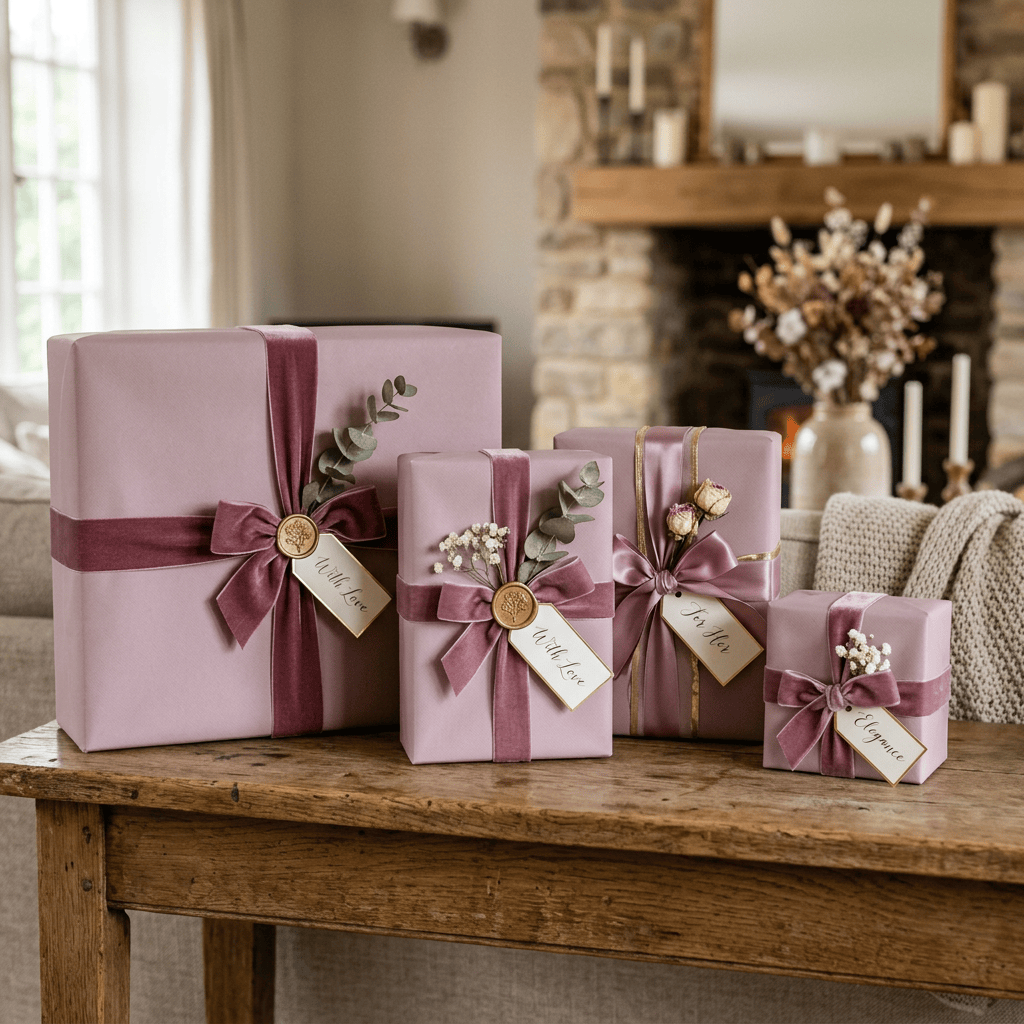
You don’t need a huge budget to give a gift that looks like a million bucks. Here’s how to make inexpensive gifts feel thoughtful, luxurious, and beautifully put together.
Have you ever picked up a beautifully wrapped gift and immediately thought, “Wow, that must have cost a fortune”?
Then you open it and discover that the actual gift is something fairly simple.
That’s the magic of presentation.
A thoughtful gift doesn’t have to be expensive to look expensive. In fact, sometimes the difference between a €10 gift that looks ordinary and a €10 gift that looks luxurious comes down to little more than the wrapping paper, ribbon, color scheme, packaging, and personal touches.
And that’s fantastic news if you’re shopping on a budget.
Whether you’re preparing a birthday present, Christmas gift, Valentine’s surprise, housewarming present, teacher gift, thank-you gift, or just a little something for someone you love, you can make almost any present feel more special without dramatically increasing the cost.
Here are the tricks that make the biggest difference.
1. Choose a Simple, Sophisticated Color Palette
One of the easiest ways to make a gift look more expensive is to stop using too many colors.
Luxury packaging often looks elegant because it is visually simple.
Instead of combining bright red paper, green ribbon, gold stars, silver bows, and a colorful gift tag, choose two or three complementary colors.
Try combinations such as:
- Cream + black + gold
- White + champagne + beige
- Navy + white + silver
- Forest green + cream + gold
- Dusty pink + burgundy + cream
- Brown kraft paper + black + white
- Deep blue + ivory + gold
You don’t need expensive wrapping paper.
Even inexpensive paper can look sophisticated when everything around it coordinates.
The secret isn’t the price of the materials. It’s consistency.
2. Upgrade Your Wrapping Paper
You don’t necessarily need to buy premium wrapping paper.
Instead, look for simple paper without an overly busy pattern.
Plain kraft paper is particularly useful because it can be transformed into almost any style.
Wrap a gift in kraft paper and add:
- A velvet ribbon
- A simple handwritten tag
- A sprig of greenery
- A wax-seal-style sticker
- A small dried flower
- Black-and-white twine
- A metallic ribbon
Suddenly, a very inexpensive wrapping material looks intentional and boutique-inspired.
Another trick?
Iron or carefully smooth your wrapping paper before using it.
Wrinkled paper instantly makes a gift look rushed. Crisp folds and clean edges make even budget wrapping look polished.
3. Use Ribbon Strategically
Ribbon can completely change the appearance of a gift.
But more ribbon isn’t necessarily better.
Instead of covering the package in an enormous bow, try using one beautiful ribbon in a contrasting or complementary color.
For example:
Brown kraft paper + black satin ribbon
or
Cream paper + burgundy velvet ribbon
or
White paper + champagne ribbon
Velvet, satin, grosgrain, and even high-quality-looking fabric ribbon can create an instantly more luxurious appearance.
And here’s a budget trick:
Buy ribbon by the roll rather than buying individual pre-made bows.
You can create your own bows and use the same ribbon across several gifts.
This also makes your presents look like they belong to the same beautifully curated collection.
4. Add a Beautiful Gift Tag
A tiny gift tag can make a surprisingly big difference.
Instead of writing the recipient’s name directly onto the package, add a small tag.
It can be as simple as:
For Emma ♡
or
A little something for you
or
Open when you’re ready to smile.
For a more luxurious look, choose tags in neutral colors with simple typography.
But don’t underestimate handwritten tags either.
A handwritten message can actually make an inexpensive gift feel more valuable emotionally, because it shows that you took the time to personalize it.
And isn’t that what gifting is really about?
5. Make the Inside Look Just as Good as the Outside
Here’s something many people overlook:
The unboxing experience matters.
You can have gorgeous wrapping on the outside, only for the recipient to open the box and find a random collection of items thrown inside.
Instead, make the inside feel intentional.
Use:
- Tissue paper
- Shredded paper filler
- Crinkle paper
- Fabric scraps
- A small amount of decorative paper
- A simple card
- Individually wrapped smaller items
Arrange everything neatly.
You don’t want the recipient to open the box and think:
“Oh, here’s a bunch of stuff.”
You want:
“Oh my gosh, look at this!”
That difference is presentation.
6. Create a Gift Box Instead of Giving One Item
A single inexpensive item can sometimes feel underwhelming.
But combine several inexpensive items around a theme, and suddenly you’ve created a curated gift set.
For example, instead of giving someone one €8 candle, create a cozy evening box:
Cozy Night In
- Small candle
- Tea sachets
- Chocolate
- Fluffy socks
- Mini notebook
- Handwritten note
None of the individual items has to be expensive.
Together, they feel thoughtful and substantial.
Other ideas include:
Self-Care Box
Bath salts + face mask + tea + candle + chocolate
Coffee Lover’s Box
Coffee beans + mug + chocolate + biscotti
Book Lover’s Box
Paperback book + bookmark + tea + chocolate
Movie Night Box
Popcorn + sweets + cozy socks + drink + movie-themed note
New Home Box
Tea towel + candle + small plant + chocolate + handwritten card
The trick is to make everything feel like it belongs together.
7. Stick to a Theme
A themed gift immediately feels more intentional.
Instead of giving someone five unrelated inexpensive objects, ask yourself:
“What story does this gift tell?”
For example:
“Everything you need for a relaxing Sunday.”
“A little box of things to brighten your week.”
“Your emergency kit for surviving Monday.”
“Everything you need for the perfect movie night.”
“A cozy little winter survival kit.”
That theme turns a collection of objects into an experience.
And experiences feel more valuable than random things.
8. Remove Unnecessary Packaging
This is a surprisingly powerful trick.
Sometimes inexpensive products look inexpensive because they’re surrounded by excessive plastic packaging, loud labels, and mismatched boxes.
If appropriate, remove unnecessary outer packaging and place the item inside a beautiful box, pouch, basket, or gift bag.
For example, instead of giving someone several small beauty products in their original packaging, arrange them together inside a simple cosmetic bag.
Instead of giving someone loose snacks, place them inside a reusable jar or decorative box.
Instead of handing over several tiny items individually, create one cohesive presentation.
Just remember to keep important product information and instructions when necessary.
9. Use Boxes Whenever You Can
There’s something about opening a box that makes a gift feel more special.
Even a relatively inexpensive item can feel elevated when presented in a beautiful box.
A box also gives you more opportunities to create an experience:
- Open the lid.
- See the tissue paper.
- Discover the handwritten note.
- Reveal the gift.
- Find the little extras underneath.
That’s an entire unboxing experience.
You don’t need an expensive gift box, either.
Plain boxes can be decorated with ribbon, stickers, labels, paper, or even a simple handwritten message.
10. Add One Unexpected Detail
Here’s one of my favorite tricks:
Add something the recipient wasn’t expecting.
It doesn’t have to be expensive.
Imagine opening a gift box and finding:
- A tiny handwritten note hidden underneath the gift
- Your favorite chocolate tucked into the corner
- A photo of the two of you
- A tiny dried flower
- A funny inside joke printed on a card
- A “redeem for one coffee together” coupon
- A playlist QR code
- A miniature ornament
- A favorite tea bag
That tiny surprise can make the entire gift feel much more personal.
And personalization is something money can’t really buy.
11. Make the Card Part of the Gift
Don’t treat the card as an afterthought.
A beautiful card can actually become part of the experience.
Instead of simply writing:
“Happy Birthday! Hope you have a great day!”
write something specific.
Mention a memory.
Tell them something you appreciate about them.
Make them laugh.
Or write something they can keep.
Even two or three genuine sentences can make a simple gift feel significantly more meaningful.
12. Use Nature to Your Advantage
You don’t have to buy expensive decorations.
Look around you.
Depending on the occasion, you might be able to use:
- Dried flowers
- Small leaves
- Rosemary
- Lavender
- Pine sprigs
- Cinnamon sticks
- Dried orange slices
A tiny botanical detail tied to a ribbon can make a simple package look beautifully styled.
For Christmas, a little evergreen sprig can instantly make kraft-paper wrapping feel festive.
For a romantic gift, a dried flower can add softness.
For a cozy autumn gift, dried leaves or a cinnamon stick can create the perfect seasonal touch.
Natural textures often look far more expensive than they cost.
13. Don’t Overdecorate
This might be the most important rule of all.
When trying to make a gift look expensive, it’s tempting to keep adding things.
More ribbon.
More stickers.
More glitter.
More decorations.
More colors.
But luxury usually works the opposite way.
Less can look like more.
Choose one focal point.
Maybe it’s the ribbon.
Maybe it’s the gift tag.
Maybe it’s a beautiful box.
Maybe it’s a dried flower.
Let that detail stand out.
If everything is competing for attention, nothing looks special.
14. Match the Presentation to the Recipient
A luxurious-looking gift doesn’t have to mean formal.
The best presentation is one that feels like the recipient.
For a minimalist friend, try:
White box + black ribbon + simple card.
For a romantic partner:
Soft-colored paper + velvet ribbon + handwritten love note.
For a teenager:
Trendy gift bag + coordinated tissue paper + personalized tag.
For a book lover:
Kraft paper + twine + bookmark + literary quote.
For a cozy-loving friend:
Neutral box + fluffy ribbon + tea + candle + handwritten note.
The goal isn’t to make every gift look like it came from a luxury department store.
It’s to make it look thoughtfully chosen.
15. Create a Signature Wrapping Style
If you give a lot of gifts, consider developing your own wrapping style.
Maybe every gift you give uses:
Kraft paper + black ribbon + handwritten cream tag.
Or:
Cream paper + burgundy velvet ribbon + gold sticker.
Or:
White boxes + pastel tissue paper + personalized labels.
Over time, people may even start recognizing your gifts before opening them.
That’s a surprisingly lovely tradition.
And because you can buy the same basic supplies in bulk, it can also be much cheaper than constantly buying different wrapping materials.
The €10 Gift That Looks Like €30
Let’s put everything together.
Imagine you’ve bought a small €10 candle.
Instead of handing it over in its original shopping bag, you could:
Step 1: Place it inside a simple cream box.
Step 2: Add a little tissue paper.
Step 3: Include their favorite chocolate.
Step 4: Add a handwritten note explaining why you chose the scent.
Step 5: Close the box with burgundy velvet ribbon.
Step 6: Attach a small gift tag.
Step 7: Add one tiny dried flower.
The actual cost hasn’t changed dramatically.
But the perceived value and emotional value have.
And that’s the real secret.
The Golden Rule of Expensive-Looking Gifts
If you remember only one thing from this article, remember this:
Expensive-looking gifts aren’t about spending more. They’re about making choices that look intentional.
Choose a cohesive color palette.
Keep the wrapping neat.
Use quality-looking textures.
Create a theme.
Add personalization.
Make the opening experience enjoyable.
And don’t overcrowd the design.
A €15 gift that feels carefully chosen and beautifully presented can easily leave a stronger impression than a €50 gift tossed into a generic bag.
Because ultimately, people don’t just remember what you gave them.
They remember how receiving it made them feel.
And sometimes, the smallest details are what make a gift unforgettable.
Quick Checklist: Make Any Gift Look More Expensive
Before handing over your present, ask yourself:
☐ Is the color palette coordinated?
☐ Is the wrapping neat and crisp?
☐ Does the ribbon complement the paper?
☐ Is there a thoughtful gift tag?
☐ Does the inside look as good as the outside?
☐ Would a small personal detail make it more meaningful?
☐ Does everything in the gift fit a theme?
☐ Have I avoided unnecessary clutter?
☐ Is there one special detail that makes it memorable?
If you can check most of these boxes, you’re already well on your way to creating a gift that looks far more expensive than it actually was.
And honestly?
That’s a gift-giving skill worth having.

Leave a comment